
Deferred Deep Linking Explained for Product Managers
One of the biggest challenges in mobile growth is losing users during app installation. Deferred deep linking preserves user intent and improves conversion.
Every mobile product manager has seen this pattern: a user clicks a campaign link, gets redirected to the App Store, installs the app, and then opens a generic home screen with no memory of what they came for. The moment is lost. This is the problem deferred deep linking solves.
What Is Deferred Deep Linking?
Deferred deep linking is a mechanism that stores the destination a user intended to reach before installing an app, and routes them to that exact destination on their very first launch.
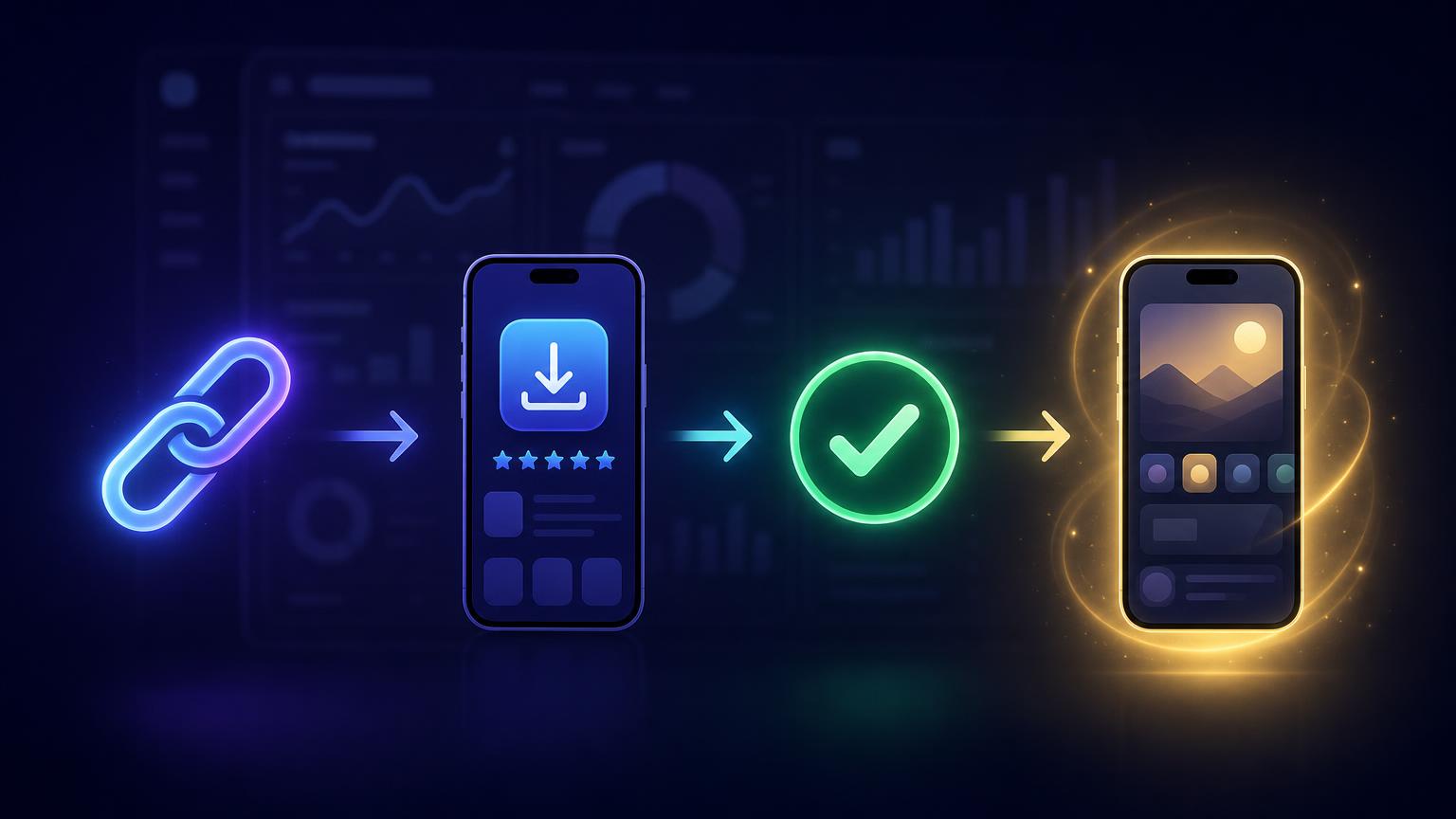
Here's the flow:
- A user clicks a deep link (from an ad, email, referral, or QR code).
- The device detects the app is not installed.
- The user is redirected to the App Store or Play Store.
- The user installs and opens the app for the first time.
- The app retrieves the stored destination and routes the user there immediately.
The key mechanism is a data store (usually a server-side lookup keyed by device fingerprint or a click ID) that bridges the gap between click and first launch.
Why Product Managers Should Care
Conversion and Activation
Post-install conversion is the metric most affected by deferred deep linking. When a user installs an app from a paid ad promoting a specific product, and they land on that product page instead of a home screen, the activation rate is measurably higher.
Referral programs are especially sensitive. A referred user who receives a personalised deep link—containing a promo code, a friend's profile, or a shared item—and lands on that exact content after install is far more likely to complete their first meaningful action.
Attribution Accuracy
Deferred deep linking improves attribution. When the platform can connect the pre-install click to the post-install session, you get accurate source attribution without relying entirely on probabilistic matching. This makes ROAS calculations more reliable.
Onboarding Personalisation
Some teams use deferred deep links to personalise onboarding. A user coming from a social campaign sees a different onboarding flow than a user from a paid search ad. The deep link carries context that the app can use to tailor the first-run experience.
How It Works on iOS and Android
iOS
On iOS, the flow uses Universal Links. When a user clicks a deep link and the app is not installed, they go to the App Store. After install, the app can retrieve the original click data via the deep linking platform's SDK on first launch.
Apple's SKAdNetwork and ATT changes in iOS 14+ have made device fingerprinting less reliable. Good platforms handle this by combining multiple signals and using click ID passthrough where possible.
Android
Android's equivalent is Android App Links. The flow is similar: click → Play Store → install → first launch retrieves destination. Android's environment is generally more permissive for device identification, making deferred routing more reliable.
Implementing Deferred Deep Linking
You can build this from scratch—but it requires maintaining server-side state, device fingerprinting, and SDK integrations on both platforms. Most product teams use a dedicated platform:
- Deeplink — API-first, fast integration, supports both platforms, good for startups and growth teams.
- Branch — enterprise-grade, robust analytics, widely deployed.
- AppsFlyer OneLink — best for teams using AppsFlyer for attribution already.
Key Metrics to Track
Once deferred deep linking is in place, track:
- Deferred open rate — percentage of installs that came via a deferred deep link.
- Intent match rate — percentage of deferred deep links that successfully routed to the correct destination.
- Post-install conversion — actions completed in the first session, segmented by deferred vs direct install.
- Campaign-level attribution — which campaigns produce deferred installs and how they convert.
Conclusion
Deferred deep linking is one of the highest-leverage improvements a mobile product team can make. It closes the context gap that costs conversion on every paid, referral, and organic campaign that touches a user before they have your app. For product managers evaluating mobile growth infrastructure, it belongs in the same tier as push notifications and app store optimisation.
Frequently Asked Questions
What is deferred deep linking?+
How is deferred deep linking different from a regular deep link?+
Why does deferred deep linking improve conversion rates?+
Does deferred deep linking work on both Android and iOS?+
Can deferred deep linking survive iOS app review?+
Ready to implement deep linking?
Deeplink gives you deferred deep linking, Android App Links, and iOS Universal Links — with a dashboard, REST API, and analytics.